A lot of the homes people fall in love with around Durango aren’t on a city street. They’re up a county road in the Animas Valley, on a few acres outside Bayfield or Hesperus, or tucked in the trees near Vallecito. These homes finance just fine most of the time, but they come with a few things a lender looks at that an in-town house doesn’t: the well, the septic system, the road and the insurance.
Here’s what to check on each, and when, so none of them turns into a surprise at the end.
The well: what the permit allows
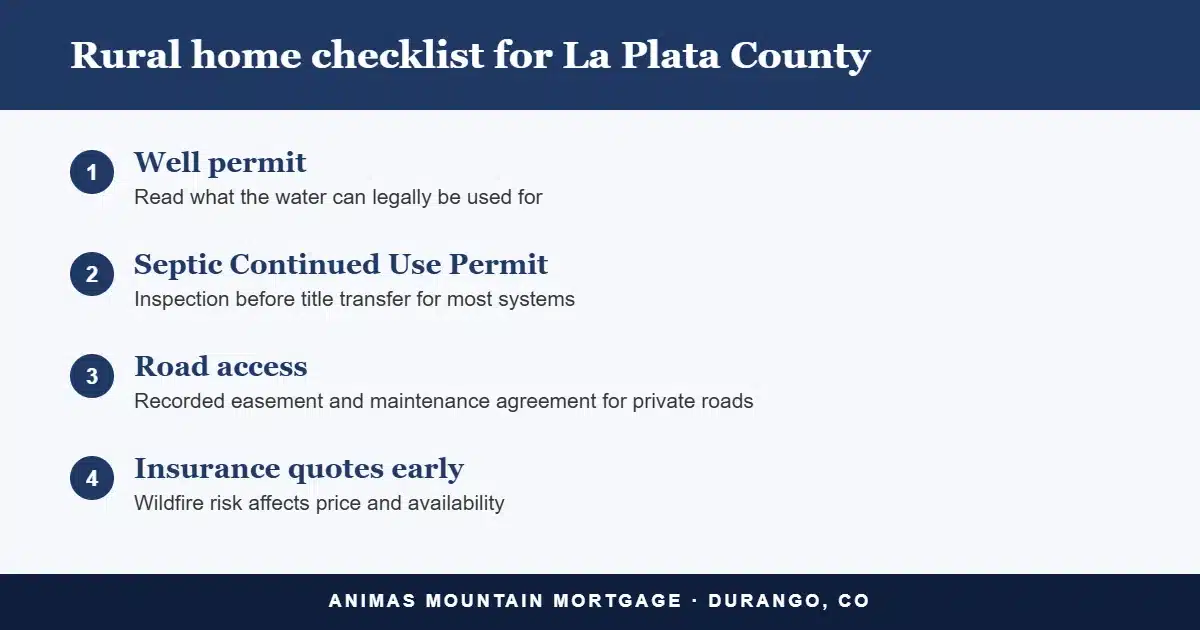
In Colorado, a private well runs under a permit from the state Division of Water Resources, and the permit spells out what the water can be used for. Many wells on smaller rural lots are “household use only.” According to Colorado State University Extension, water from those wells can be used only inside the home, not for watering a garden, trees or livestock. If you’re picturing a big garden or horses, read the permit before you make an offer.
For the loan, the appraiser notes that the home is on a well, and depending on the loan program, a water test may be required. Even when it isn’t, I recommend one. After closing, the well permit’s owner information is updated through the state, usually by the title company.
The septic system: La Plata County requires an inspection at sale
Since 2019, most homes with a septic system in La Plata County need a Continued Use Permit from the La Plata County Public Health Department before ownership can transfer. That means an inspection by a certified third-party inspector within the past year, and pumping by a licensed cleaner if the tank needs it. Newer systems and some transfers, such as inheritances, are exempt.
If the inspection finds a problem, someone has to fix it, and who pays is something to negotiate in the contract. In winter, when frozen ground makes repairs impossible, the county can issue a conditional permit if the buyer agrees in writing to finish the work later. Lenders want to see this resolved, so it’s worth building the inspection into your timeline from the start. If the home needs bigger repairs, a renovation loan can finance them along with the purchase; see my guide to fixer-upper loans in Durango.
The road: access has to be legal and year-round
Every loan program wants the home to have legal, permanent access. If the home is on a private road, the lender usually needs a recorded easement and, for many programs, a road maintenance agreement that says who plows and repairs it. FHA, VA and USDA loans also look for all-weather access. Plenty of older rural subdivisions around here never recorded a maintenance agreement. It can usually be fixed, but it takes neighbors signing something, so it’s better found early.
Insurance: shop it before you’re under contract
Homeowners insurance is required for any mortgage, and in wildfire country it has become harder and more expensive to get. Get quotes as soon as you’re serious about a property, not after the inspection. Ask about wildfire mitigation. Defensible space and a newer roof can matter to insurers.
If private insurers turn a home down, Colorado now has a last-resort option. The Colorado FAIR Plan launched in April 2025 for homeowners who can’t get coverage elsewhere because of wildfire or hail risk. It’s sold through licensed agents and has a coverage cap, so it isn’t a fit for every home. Your insurance agent can tell you whether it applies.
The appraisal: fewer comparable sales
Appraisers value a home by comparing it with similar recent sales. For a unique mountain property or a home on acreage, there may be few close matches, so the appraisal can take longer and the appraiser may have to reach further for comparisons. Lenders also look at whether the acreage and outbuildings are typical for the area. A property that’s mostly land value, or that’s used as a working farm or ranch, may need a different kind of loan. If you’re looking at a larger or higher-priced property, my guide to jumbo loans in Durango covers more of this.
My checklist for rural buyers
- Get pre-approved first, and tell me the property is rural so we pick the right loan program.
- Ask for the well permit and read what it allows.
- Put the septic inspection and Continued Use Permit in the contract timeline.
- Ask whether the road is public or private, and whether there’s a recorded maintenance agreement.
- Get insurance quotes in the first few days of your inspection period.
- Ask about propane, internet and winter plowing. They won’t stop a loan, but they matter for living there.
Questions I hear about rural homes
Can I use a USDA loan for a rural home near Durango?
Often, yes, if the property is in an eligible area and your household income fits the limits. My USDA guide for Bayfield, Ignacio and rural La Plata County explains how to check an address.
Does a shared well cause problems?
It can. Lenders usually want a recorded shared-well agreement that covers access, maintenance and costs. If one doesn’t exist, it’s worth getting before closing.
What about manufactured homes on land?
Some loan programs finance manufactured homes that are permanently attached to land and taxed as real property, with extra requirements. Tell me early and I’ll check which programs fit.
Ask me before you make an offer
I’ve financed homes on wells, septic systems and dirt roads all over Southwest Colorado for 28 years, and most problems are easy to solve when they’re found early. If you’re looking at a mountain or rural property, call or text me at 970-828-1610 or reach out through my contact page, and I’ll tell you what we’re likely to run into. You can also learn more about working with a local Durango mortgage lender.
Peter Pritchard
Not affiliated with or endorsed by the U.S. Department of Veterans Affairs, HUD or USDA.
This article is for general information only and is not financial or legal advice. Loan programs, terms and availability vary.
Peter Pritchard NMLS #404172 | Animas Mountain Mortgage Inc. NMLS #1742747 | Equal Housing Opportunity. All loans subject to credit approval.
All Articles
SEE MOREBuying a Home in Durango This Winter: A Local Lender’s Checklist November 4, 2026
Six things to plan for when you buy a home in Durango between November and March, from pre-approval timing to snowy inspections and holiday closings.
Buying a Duplex in Durango: Live in One Unit, Rent the Others November 1, 2026
You can buy a duplex, triplex or fourplex in Durango, live in one unit and rent the others, and finance it as your own home. Here is how FHA, VA and conventional loans work for it, the LLC question, and what to check in La Plata County.
Fixer-Upper Loans in Durango: FHA 203(k) vs. Fannie Mae HomeStyle October 26, 2026
You can buy a home that needs work and finance the repairs in the same loan. Here is how FHA 203(k) and Fannie Mae HomeStyle renovation loans work in Durango and Southwest Colorado, and which one fits.