If you’re building a home in La Plata County, you’ll usually need a construction loan that pays your builder in stages while the house goes up, then becomes (or is replaced by) a regular mortgage once it’s finished. I do one-time close construction loans, and permanent loans that pay off a bank or builder’s construction loan when the house is done. Either way, the big question is how ready your lot, plans and permits are before a lender will commit.
Building out here has local wrinkles (wells, septic, snow loads and county permits) that can add weeks before the first shovel hits the ground. Here’s how it fits together.
How does a construction loan work?
A purchase loan pays a seller once, at closing. A construction loan pays out in draws: money is released as the builder finishes stages of the work, usually after a progress check. During construction, many loans charge interest only on the money drawn so far, not on the full loan amount.
The appraisal is based on your plans and specifications, valuing the home as it will be when it’s finished. When construction wraps up, the appraiser comes back to confirm the house was built as planned. Fannie Mae, for example, calls for a completion report (Form 1004D) at that point.
The two ways I finance a build
One-time close (construction-to-permanent)
You apply once and close once. The loan pays your builder in draws, and when the home is finished it converts to your permanent mortgage. The upside is one set of closing costs and knowing your long-term loan terms before you start. The trade-off: Fannie Mae’s single-closing rules cap the construction period, so a long build may fit better with a separate construction loan and a permanent takeout at the end.
Permanent takeout (a bank or builder carries the construction loan)
If a bank or your builder provides the short-term construction loan, I can do the permanent mortgage that pays it off when the house is finished. That leaves more room for a longer or more complex build. The trade-offs are two closings with two sets of costs, and you qualify again at the end, so if your income, credit or the market changes during the build, the permanent loan isn’t guaranteed. I don’t make the short-term construction loan itself, so talk to me before you sign one and we’ll plan the permanent loan from the start.
What lenders look at before you break ground
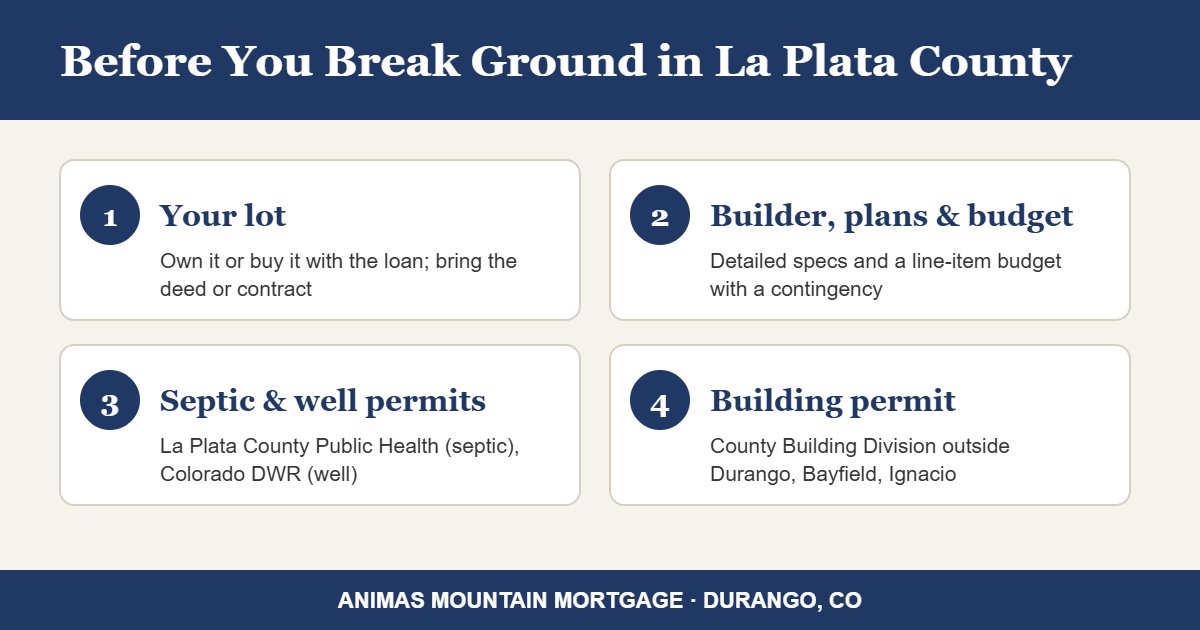
- Your lot. Whether you already own the land or are buying it as part of the loan. If you own it, bring the deed and tell me what you paid and whether there’s still a loan on it.
- Your builder. Most lenders review the builder: licensing, insurance and track record.
- Plans, specs and a budget. A detailed, line-item budget with a contingency for surprises.
- You. Income, credit and assets, plus enough cushion to handle overruns.
La Plata County permits that affect your construction loan
Outside the City of Durango and the towns of Bayfield and Ignacio (and outside Southern Ute tribal land and state or federal land), building permits come from La Plata County’s Building Division. Inside those towns, the town or city handles it. The county’s permit packet asks for your septic and well permits with the application, so those come first:
- Septic. La Plata County Public Health issues septic (OWTS) permits. Every new system needs a site and soil evaluation and a design, and an engineer may be required depending on the soils.
- Well. The Colorado Division of Water Resources issues residential well permits, and says reviewing a complete application can take up to 49 days.
- Building permit. The county says review typically takes 4 to 8 weeks. Its packet notes that heavy snow-load designs may need a licensed engineer, and sites mapped with expansive clay soils need a soils report or engineered foundation.
Why it matters: a construction loan’s clock starts at closing, so line up permits first and less build time goes to waiting. On rural lots near Hesperus, Vallecito, Bayfield or Ignacio, wells, septic and road access are where I see the most surprises. My guide to buying a mountain or rural home near Durango covers those in more detail.
Should you build, buy or renovate in Durango?
Building gets you exactly the house you want, but takes longer than buying. If the numbers or timeline don’t work, buying an existing home and improving it with a renovation loan in Durango is worth comparing. I’ll run both honestly, even if the answer is “wait.”
How I help with construction financing
As one of the mortgage lenders in Durango, CO who also shops multiple lenders, I’ll lay out which construction options fit your project and where the timing risks are. Start with a pre-approval in Durango so you know your budget before plans are final.
Construction loan FAQ
Can I use land I already own toward a construction loan in La Plata County?
Often, yes. Many programs take land you already own into account when sizing the loan. How much it helps depends on the program, what you paid and whether there’s a loan on the lot, so bring your deed and I’ll show you how each option treats it.
Do I need septic and well permits before a building permit in La Plata County?
In unincorporated La Plata County, yes. The county’s building permit packet asks for the septic permit from La Plata County Public Health and the well permit from the Colorado Division of Water Resources. If a water or sewer district serves the lot, you need the district’s written authorization instead.
Can you do my mortgage if a bank does the construction loan?
Yes. That’s a permanent takeout: when the house is finished, I do the permanent mortgage that pays off the bank’s construction loan. You’ll close twice and qualify again at the end, so talk to me before you sign the construction loan. If you’d rather close once, I also do one-time close construction loans.
Thinking about building? Call or text me at 970-828-1610 and I’ll call you back the same day, or send a note through my contact page. If you’re still working out a budget, my home price range tool gives you a realistic range in a couple of minutes, before you sit down with a builder.
Peter Pritchard
Sources: La Plata County Community Development, Building Permit Application Packet (revised Feb. 2024); La Plata County Public Health Department, Onsite Wastewater Treatment System Regulations (effective March 2, 2026) and OWTS application; Colorado Division of Water Resources, Well Permitting; Fannie Mae Selling Guide B5-3.1-02 and B5-3.1-03 (construction-to-permanent financing).
All Articles
SEE MOREBuying a Home in Durango This Winter: A Local Lender’s Checklist November 4, 2026
Six things to plan for when you buy a home in Durango between November and March, from pre-approval timing to snowy inspections and holiday closings.
Buying a Duplex in Durango: Live in One Unit, Rent the Others November 1, 2026
You can buy a duplex, triplex or fourplex in Durango, live in one unit and rent the others, and finance it as your own home. Here is how FHA, VA and conventional loans work for it, the LLC question, and what to check in La Plata County.
Fixer-Upper Loans in Durango: FHA 203(k) vs. Fannie Mae HomeStyle October 26, 2026
You can buy a home that needs work and finance the repairs in the same loan. Here is how FHA 203(k) and Fannie Mae HomeStyle renovation loans work in Durango and Southwest Colorado, and which one fits.